Snook regulations
Florida · Curated reference from cited public sources · listings, not permission to fish or retain a catch · This selected Florida saltwater reference subset is not a complete rulebook.
FIELD GUIDE
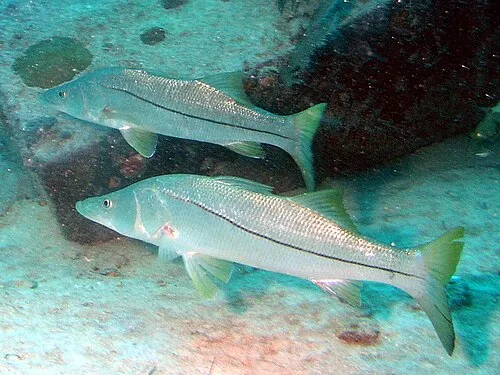
Centropomus undecimalis
speciesREVIEWEDThe common snook, also called the sergeant fish or robalo. Spawns in near-shore high-salinity waters; juveniles migrate to brackish estuarine environments.
HABITAT
Near-shore waters and brackish estuaries of the tropical western Atlantic.
SIZE
max 140 cm (4.6 ft); common 50 cm
IDENTIFY
Common snook (Centropomus undecimalis) have a sloping forehead, protruding lower jaw, divided dorsal fins, yellow pelvic and caudal fins, and a crisp black lateral line extending all the way to the tip of the tail.
LOOK-ALIKES
Florida waters host several smaller Centropomus species (tarpon snook, fat snook, swordspine snook); common snook grow substantially larger and have fewer lateral-line scales and shorter anal-fin spines than swordspine or tarpon snook.
WHERE
Inhabit mangrove shorelines, passes, inlets, bridges, beaches, and brackish coastal rivers, typically in shallow water under 65 feet where water temperatures stay above 60 °F.
WHEN
Snook congregate in coastal passes and along beaches from late spring through summer to spawn, then retreat into warmer rivers, canals, and backcountry basins during winter cold fronts.
TECHNIQUE
Live baitfish, shrimp, flair-hawk jigs in passes, and swimbaits or topwater plugs pitched tight to mangrove roots and dock shadow lines are standard inshore methods.
HANDLE
Support heavy snook horizontally with two wet hands — never hang large fish vertically by the jaw or a lip-grip tool — and revive them facing into moving water before letting go.
CONSERVATION
Snook are protandric hermaphrodites (maturing first as males before transitioning to large spawning females) and are vulnerable to severe cold kills and red tide events, driving FWC's multi-region slot and season management.
RULES
Florida divides snook into multiple regional management zones with narrow harvest slot limits, seasonal closures, and a required Snook Permit — verify the exact county/region map before retaining.
SOURCE
FACT-CHECKED 2026-11-13 · REVIEWER fact-check-lane
TEXT CONDENSED FROM WIKIPEDIA, AVAILABLE UNDER CC BY-SA 4.0
Snook identification is educational; species identification does not establish legal applicability for Florida.
- LISTED LIMIT
- 1 fish per person per day
- LISTED MIN SIZE
- 28 inches
- LISTED MAX SIZE
- 33 inches
- LISTED SEASON WINDOWS
- Mar 1, 2026 through Apr 30, 2026 · 1 fish listed
- Sep 1, 2026 through Nov 30, 2026 · 1 fish listed
- APPLICABILITY
- Panhandle Region: closed December 1-end of February and May 1-August 31; slot 28-33 inches total length. Other regions vary, including 28-32-inch slots and different closure dates.
- SOURCE AUTHORITY
- Florida Fish and Wildlife Conservation Commission, Snook recreational regulations
UPDATED January 1, 2026 · CHECKED Nov 16, 2026, 12:00 PM UTC · EFFECTIVE YEAR 2026
FWC saltwater fishing regulations ↗The FWC page is an informational summary; the Florida Administrative Code and emergency orders are authoritative.
LAUNCH SITES
Curated launch sites in Florida (9)
Florida · MARINA
Florida · MARINA
Florida · MARINA
Florida · DOCK
Florida · MARINA
Florida · MARINA
Florida · MARINA
Florida · MARINA
Florida · MARINA
This reference does not grant permission to fish or retain a catch. Location, method, vessel, species identification, and emergency closures can change what applies. Verify the applicable official rules.