‘Ahi (tuna) regulations
Hawaii · Curated reference from cited public sources · listings, not permission to fish or retain a catch · This selected Hawaii marine reference subset is not a complete rulebook.
FIELD GUIDE
Thunnus albacares
speciesREVIEWEDA tuna of tropical and subtropical oceans worldwide, marketed in Hawaii as ahi. One of the larger tuna species, found in the pelagic surface layer above the thermocline.
HABITAT
Open-ocean pelagic waters of tropical and subtropical seas worldwide.
SIZE
over 180 kg (400 lb) reported
IDENTIFY
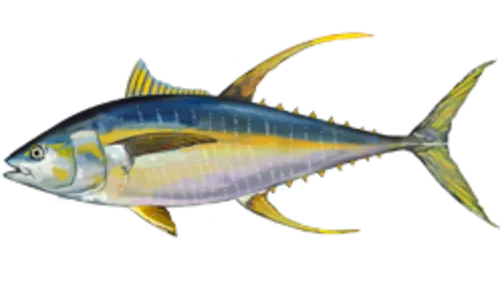
Yellowfin tuna / ahi (Thunnus albacares) have metallic dark-blue backs, silver bellies crossed by faint broken vertical pale lines, bright yellow finlets edged in black, and elongated sickle-shaped yellow second dorsal and anal fins on larger fish.
LOOK-ALIKES
Separate smaller yellowfin from bigeye tuna carefully where Atlantic HMS or Pacific limits apply: bigeye have larger eyes, deeper bodies, pectoral fins reaching past the second dorsal origin without yellowfin's long sickle lobes, and striated livers.
WHERE
Open-ocean pelagic swimmers inhabiting the upper mixed layer above the thermocline around seamounts, shelf canyons, current boundaries, bird piles, and anchored FADs.
WHEN
Caught year-round in Hawaii, Puerto Rico, and Gulf offshore waters, with strong summer-autumn canyon and coastal runs along Southern California and the Mid-Atlantic.
TECHNIQUE
Trolling cedar plugs, skirted lures, and spreader bars, chunking butterfish or sardines on canyon drifts, or live-baiting and kite-fishing offshore.
HANDLE
Tuna ram-ventilate and suffocate if held stationary out of water; keep undersize fish moving alongside the boat in the water while popping the hook free.
CONSERVATION
Managed internationally across Pacific (WCPFC/IATTC) and Atlantic (ICCAT / NOAA Highly Migratory Species) conventions with permit, curved-fork-length, and bag requirements.
RULES
In Atlantic, Gulf, and Caribbean federal waters, targeting tunas requires a federal NOAA HMS Angling or Charter/Headboat permit and curved-fork-length measurement — verify HMS rules before offshore departure.
SOURCE
FACT-CHECKED 2026-11-13 · REVIEWER fact-check-lane
TEXT CONDENSED FROM WIKIPEDIA, AVAILABLE UNDER CC BY-SA 4.0
‘Ahi (tuna) identification is educational; species identification does not establish legal applicability for Hawaii.
- LISTED LIMIT
- Under 3 pounds: possession with intent to sell or offering for sale is prohibited; spearing or possessing speared fish is prohibited. HAR §13-95-17 establishes no general hook-and-line recreational minimum or bag limit.
- APPLICABILITY
- HAR §13-95-17 restricts under-3-pound ahi only for commercial sale and spearing; it does not establish a general minimum for noncommercial hook-and-line catch. No season or bag limit is stated in this rule.
- SOURCE AUTHORITY
- Hawaii Administrative Rules §13-95-17, current chapter 13-95 compilation hosted by Hawaii DLNR DAR (amendments through February 22, 2024)
UPDATED February 22, 2024 · CHECKED Nov 15, 2026, 12:00 PM UTC · EFFECTIVE YEAR 2026
DLNR Division of Aquatic Resources regulations ↗The DLNR page is an informational summary; the applicable administrative rules are authoritative.
LAUNCH SITES
Curated launch sites in Hawaii (1)
This reference does not grant permission to fish or retain a catch. Location, method, vessel, species identification, and emergency closures can change what applies. Verify the applicable official rules.