Red Snapper regulations
Louisiana · Curated reference from cited public sources · listings, not permission to fish or retain a catch · This selected Louisiana saltwater reference subset is not a complete rulebook.
FIELD GUIDE
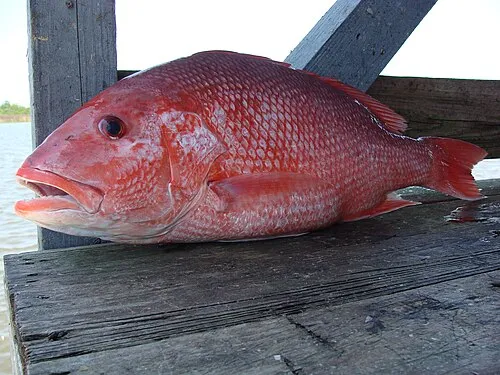
Lutjanus campechanus
speciesREVIEWEDThe northern red snapper, native to the western Atlantic, Caribbean, and Gulf of Mexico, inhabiting reef-associated environments. Long-lived, with an oldest reported age over 57 years.
HABITAT
Reef-associated environments of the western Atlantic, Caribbean, and Gulf of Mexico.
SIZE
common 60 cm (24 in); up to 100 cm
IDENTIFY
Northern red snapper (Lutjanus campechanus) have a deep pinkish-red body fading to pale silver-rose on the belly, a bright red iris, a pointed snout, a triangular anal fin, and no dark lateral spot on adults.
LOOK-ALIKES
Check the anal fin and eye: red snapper have a pointed (angular) anal fin and red eye, whereas vermilion snapper have a rounded anal fin, forked tail, and streamlined body, and lane/mutton snappers retain a dark side spot.
WHERE
Adults congregate over natural hard-bottom ledges, coral outcrops, artificial reefs, wrecks, and offshore platforms typically from 60 to 400 feet in the Gulf and South Atlantic.
WHEN
Spawning occurs offshore from May through October; federal and state recreational harvest windows are tightly quota-managed and often last only specific days or weeks.
TECHNIQUE
Bottom rigs and jigs fished over hard structure are standard. In federal reef-fish waters, non-stainless circle hooks are required when fishing with natural bait (north of 28°N in the South Atlantic), and barotrauma gear is mandatory — a rigged descending device or venting tool in the Gulf, and a rigged descending device onboard in the South Atlantic.
HANDLE
Fish brought up from depth frequently show barotrauma (protruding stomach, bloated belly, bulging eyes). Return released snapper rapidly to depth using a rigged descending device rather than leaving them floating at the surface.
CONSERVATION
Red snapper can live more than 50 years; reducing discard mortality with descending devices and circle hooks is central to both South Atlantic rebuilding and Gulf quota management.
RULES
State-water seasons (including Gulf state reef-fish surveys/permits) and federal EEZ openings frequently differ sharply by vessel mode (private vs. charter) — verify both boundary and date before launching.
SOURCE
FACT-CHECKED 2026-11-13 · REVIEWER fact-check-lane
TEXT CONDENSED FROM WIKIPEDIA, AVAILABLE UNDER CC BY-SA 4.0
Red Snapper identification is educational; species identification does not establish legal applicability for Louisiana.
- LAST LISTED/REFERENCE LIMITS
- Four fish per person per day during the announced open windows; closed outside those windows. LDWF states the season is closed until further notice after September 7, 2026. · minimum 16 inches
- LISTED SEASON WINDOWS
- May 1, 2026 through Aug 9, 2026 · 4 fish listed
- Aug 10, 2026 through Aug 26, 2026 · 0 fish listed
- Aug 27, 2026 through Aug 30, 2026 · 4 fish listed
- Aug 31, 2026 through Sep 3, 2026 · 0 fish listed
- Sep 4, 2026 through Sep 7, 2026 · 4 fish listed
- Sep 8, 2026 through Dec 31, 2026 · 0 fish listed
- APPLICABILITY
- Sixteen-inch minimum total length. LDWF reopened the private recreational season August 27-30 and September 4-7, 2026 at four fish per person per day, then closed it until further notice; it remained closed on October 7, 2026.
- SOURCE AUTHORITY
- Louisiana Department of Wildlife and Fisheries, Recreational Saltwater Finfish — Red Snapper; August 7, 2026 closure notice; August 21, 2026 reopening notice; current LDWF Red Snapper status (closed as of October 7, 2026)
UPDATED August 21, 2026 · CHECKED Oct 22, 2026, 12:00 PM UTC · EFFECTIVE YEAR 2026
LDWF recreational fishing regulations ↗The LDWF page is an informational summary; the applicable state statutes and emergency orders are authoritative.
COAST-TO-COAST COMPARISON
Red Snapper rules across 6 other coastal states
LAUNCH SITES
Curated launch sites in Louisiana (1)
This reference does not grant permission to fish or retain a catch. Location, method, vessel, species identification, and emergency closures can change what applies. Verify the applicable official rules.