Dungeness Crab (ocean) regulations
Oregon · Curated reference from cited public sources · listings, not permission to fish or retain a catch · This selected Oregon marine reference subset is not a complete rulebook.
FIELD GUIDE
Metacarcinus magister
speciesREVIEWEDOne of the most important seafood species of the North American west coast, ranging from the Aleutians to Point Conception, California. Named for Dungeness Spit in the Strait of Juan de Fuca.
HABITAT
Eelgrass beds and sandy bottoms.
SIZE
6–7 in wide, males up to 9 in
IDENTIFY
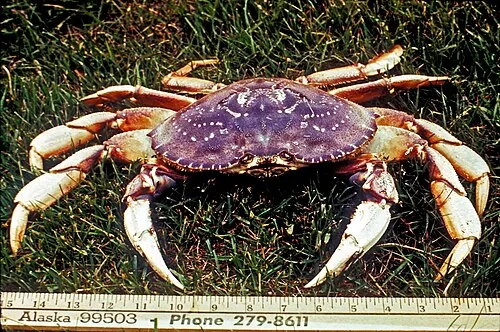
Dungeness crab (Metacarcinus magister) have a broad, purplish-brown to tan oval carapace whose widest point sits at the tenth anterolateral spine, with white-tipped claws that carry serrated inner teeth.
LOOK-ALIKES
Separate Dungeness from red rock crab and graceful crab by the claw tips: Dungeness crab have white-tipped pincers, whereas rock crabs have black-tipped claws and a smoother, brick-red carapace.
WHERE
Inhabit sandy and silty-sand bottoms and eelgrass beds from coastal bays and estuaries out across the continental shelf to depths past 300 feet.
WHEN
Recreational seasons typically run from late autumn through spring or summer depending on state, though openings are frequently delayed for whale entanglement risk or domoic acid biotoxin advisories.
TECHNIQUE
Baited crab traps, hoop nets, and crab snares worked over sandy bottoms are standard recreational methods. Weight traps and rig biodegradable escape cords and buoy markings as required by state code.
HANDLE
Check sex and carapace width immediately with a rigid crab gauge across the curve just in front of the tenth points (excluding spines); return undersize or soft-shell crabs — and all females in male-only West Coast fisheries (CA/OR/WA; check area rules in Alaska) — gently to the water.
CONSERVATION
Male-only harvest rules and minimum carapace gauges ensure mature males can mate at least once or twice before entering the fishery, while trap-limit and whale-safe rules reduce vertical-line entanglements.
RULES
Always check state biotoxin health advisories, whale-entanglement trap restrictions, buoy tag rules, report cards or catch record cards, and whether bays vs. ocean waters have separate rules.
SOURCE
FACT-CHECKED 2026-11-13 · REVIEWER fact-check-lane
TEXT CONDENSED FROM WIKIPEDIA, AVAILABLE UNDER CC BY-SA 4.0
Dungeness Crab (ocean) identification is educational; species identification does not establish legal applicability for Oregon.
- LAST LISTED/REFERENCE LIMITS
- 12 male crabs per day; minimum size 5.75 inches. · minimum 5.75 inches
- LISTED SEASON WINDOWS
- Dec 1, 2026 through Oct 15, 2027 · 12 fish listed
- APPLICABILITY
- Columbia Zone ocean waters: closed Oct. 16-Nov. 30; bays, beaches, estuaries, tide pools, piers, and jetties are open year-round, 24 hours/day. Only males may be kept; up to 3 rings/lines/pots per person.
- SOURCE AUTHORITY
- Oregon Department of Fish & Wildlife, “Columbia Zone” shellfish regulation highlights and Aug. 13, 2026 “Crabbing & Clamming Report - Marine Zone.”
UPDATED August 13, 2026 · CHECKED Oct 8, 2026, 12:00 PM UTC · EFFECTIVE YEAR 2026
ODFW marine zone regulations ↗The ODFW page is an informational summary; the applicable administrative rules and in-season actions are authoritative.
COAST-TO-COAST COMPARISON
Dungeness Crab (ocean) rules across 2 other coastal states
LAUNCH SITES
Curated launch sites in Oregon (5)
This reference does not grant permission to fish or retain a catch. Location, method, vessel, species identification, and emergency closures can change what applies. Verify the applicable official rules.