Pacific Halibut regulations
Oregon · Curated reference from cited public sources · listings, not permission to fish or retain a catch · This selected Oregon marine reference subset is not a complete rulebook.
FIELD GUIDE
Hippoglossus stenolepis
speciesREVIEWEDOne of the largest flatfish, surpassed only by the closely related Atlantic halibut. Native to the North Pacific and fished commercially, recreationally, and for subsistence.
HABITAT
North Pacific continental shelf; mature fish spawn along the shelf edge at 183–457 m.
SIZE
females up to 230 kg (510 lb)
IDENTIFY
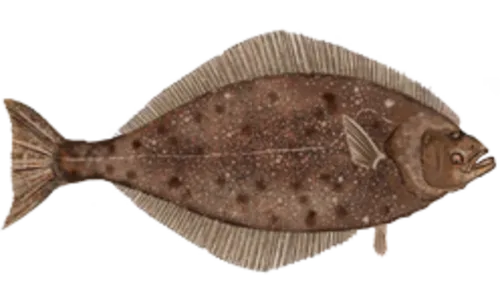
Pacific halibut (Hippoglossus stenolepis) are diamond-shaped, right-eyed flatfish with a mottled brown-olive upper side, white blind side, concave lunate tail fin, and a lateral line that arches sharply over the pectoral fin.
LOOK-ALIKES
Confirm the high arch in the lateral line over the pectoral fin and the diamond body outline; arrowtooth flounder and starry flounder have straighter lateral lines or bold black-and-white fin bars.
WHERE
Juveniles inhabit nearshore sandy bays and shelf shallows, while larger adults feed over sand, gravel, and cobble banks from coastal shelf waters down past 900 feet along the continental slope.
WHEN
Adults migrate onto shallower coastal banks from spring through summer to feed and return to deeper shelf-edge waters in late autumn and winter to spawn.
TECHNIQUE
Stout bottom tackle with weighted pipe jigs, leadhead swimbaits, or circle-hook bait rigs fished near hard-to-sand transitions are standard. Account for tidal current speed so gear holds bottom cleanly.
HANDLE
Halibut lack a swim bladder and do not suffer gas-expansion barotrauma, but large fish can injure crew and themselves on deck; release unwanted or slot-protected halibut boatside in the water without gaffing.
CONSERVATION
Pacific halibut are jointly managed by the United States and Canada through the International Pacific Halibut Commission with catch-sharing quotas across Alaska and West Coast subareas.
RULES
Halibut openings frequently run on specific days of the week, charter vs. private-vessel rules, reverse-slot limits, and annual harvest caps that close in-season — check IPHC, NOAA, and state notices.
SOURCE
FACT-CHECKED 2026-11-13 · REVIEWER fact-check-lane
TEXT CONDENSED FROM WIKIPEDIA, AVAILABLE UNDER CC BY-SA 4.0
Pacific Halibut identification is educational; species identification does not establish legal applicability for Oregon.
- LAST LISTED/REFERENCE LIMITS
- 2 Pacific halibut per day in Central Oregon Coast and Southern Oregon subareas; annual limit 6; possession 1 daily bag at sea and 3 daily bags on land.
- LISTED SEASON WINDOWS
- May 1, 2026 through Jul 31, 2026 · 2 fish listed
- Aug 1, 2026 through Oct 31, 2026 · 2 fish listed
- APPLICABILITY
- Central Oregon Coast subarea (Humbug Mountain to Cape Falcon): spring all-depth May 1-Jul. 31 and summer all-depth Aug. 1-Oct. 31, seven days/week or until quota. No length limit; nearshore May 1-Oct. 31 may apply if an all-depth season closes early.
- SOURCE AUTHORITY
- Oregon Department of Fish & Wildlife, “Pacific halibut sport regulations,” 2026 Recreational Pacific Halibut.
UPDATED April 29, 2026 · CHECKED Oct 8, 2026, 12:00 PM UTC · EFFECTIVE YEAR 2026
ODFW marine zone regulations ↗The ODFW page is an informational summary; the applicable administrative rules and in-season actions are authoritative.
COAST-TO-COAST COMPARISON
Pacific Halibut rules across 2 other coastal states
LAUNCH SITES
Curated launch sites in Oregon (5)
This reference does not grant permission to fish or retain a catch. Location, method, vessel, species identification, and emergency closures can change what applies. Verify the applicable official rules.