Spotted Seatrout regulations
Texas · Curated reference from cited public sources · listings, not permission to fish or retain a catch · This selected Texas saltwater reference subset is not a complete rulebook.
FIELD GUIDE
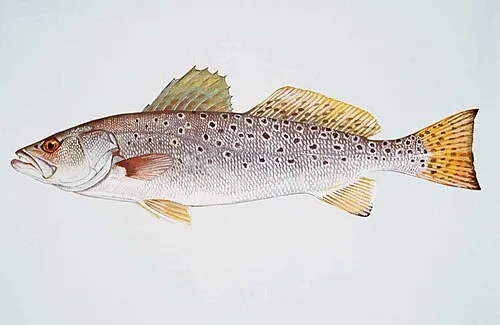
Cynoscion nebulosus
speciesREVIEWEDThe speckled trout, a common estuarine fish of the southern United States along the Gulf of Mexico and Atlantic coasts from Maryland to Florida. Resides in virtually any inshore water, from surf to coastal rivers.
HABITAT
Shallow grassy flats and virtually all inshore waters of the southeastern US.
SIZE
adults 19–37 in and 3–17 lb
IDENTIFY
On the Atlantic coast, spotted seatrout (Cynoscion nebulosus) occur from Cape Cod, Massachusetts to the Florida Keys, but are most abundant from the Chesapeake Bay southward.
LOOK-ALIKES
Spotted seatrout (Cynoscion nebulosus) have distinct round black spots scattered across the back and onto the soft dorsal and tail fins, unlike weakfish (Cynoscion regalis), whose smaller spots form oblique wavy rows and leave the tail fin unspotted.
WHERE
Spotted seatrout are primarily estuarine and may move into nearshore ocean water during cold periods. Adults use grass beds, oyster beds, creek mouths, drop-offs, and structure, and are most abundant in relatively shallow water.
WHEN
Along the Atlantic coast, spawning occurs around estuary inlets from April through September. The species is generally non-migratory, although some Chesapeake fish move seasonally.
TECHNIQUE
ASMFC describes spotted seatrout feeding primarily on shrimp and fish. Match a bait or lure profile to that prey and local conditions, without treating habitat notes as a precise fishing recommendation.
HANDLE
NOAA recommends wet hands, minimal handling and air exposure, avoiding eyes and gills, and dehooking in the water when possible. Release outcomes vary with the fish and conditions.
CONSERVATION
ASMFC reports no range-wide assessment for spotted seatrout and says local assessments vary by state; estuarine habitat, release mortality, and local environmental events are part of the management context.
RULES
Use the current state or interstate listing for the exact jurisdiction, season, water boundary, method, vessel, size, and possession rule. This field guide is separate from the official rule listing.
SOURCE
FACT-CHECKED 2026-09-03 · REVIEWER fact-check-lane
TEXT CONDENSED FROM WIKIPEDIA, AVAILABLE UNDER CC BY-SA 4.0
Spotted Seatrout identification is educational; species identification does not establish legal applicability for Texas.
- LISTED LIMIT
- Possession limit is double the 3-fish daily bag. During a license year, one fish over 28 inches may be retained with a Spotted Seatrout Tag and one with a Bonus Spotted Seatrout Tag; tagged fish are additional to daily bag and possession limits.
- LISTED MIN SIZE
- 15 inches
- LISTED MAX SIZE
- 20 inches
- APPLICABILITY
- TPWD 2026-27 Seatrout page lists the general 15- to 20-inch rule and the two stated over-28-inch tag exceptions. TPWD marks these 2026-27 rules valid September 1, 2026 through August 31, 2027 — before September 1 the prior season's rules apply.
- SOURCE AUTHORITY
- Texas Parks and Wildlife Department, Seatrout Bag & Length Limits, 2026-27 Outdoor Annual
UPDATED September 1, 2026 · CHECKED Nov 16, 2026, 12:00 PM UTC · EFFECTIVE YEAR 2026
TPWD outdoor annual saltwater regulations ↗The TPWD page is an informational summary; the Texas Administrative Code and emergency orders are authoritative.
COAST-TO-COAST COMPARISON
Spotted Seatrout rules across 8 other coastal states
LAUNCH SITES
Curated launch sites in Texas (4)
This reference does not grant permission to fish or retain a catch. Location, method, vessel, species identification, and emergency closures can change what applies. Verify the applicable official rules.