Cabezon (Marine Areas 1-4) regulations
Washington · Curated reference from cited public sources · listings, not permission to fish or retain a catch · This selected Washington saltwater reference subset is not a complete rulebook.
FIELD GUIDE
Scorpaenichthys marmoratus
speciesREVIEWEDA large sculpin native to the Pacific coast of North America — the only known member of its genus, whose name translates literally as "scorpion fish."
HABITAT
Rocky, muddy, and sandy bottoms and kelp beds from Sitka, Alaska, to Baja California, 0–200 m.
SIZE
up to 99 cm (3 ft 3 in) and 14 kg (31 lb)
IDENTIFY
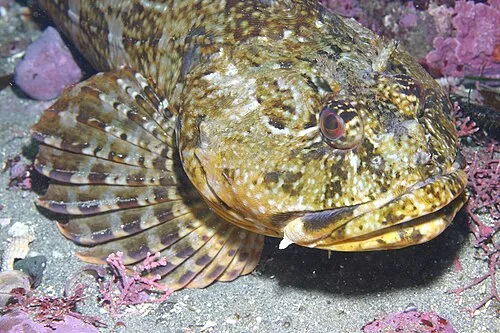
Cabezon (Scorpaenichthys marmoratus) are scaleless, heavy-headed sculpins with mottled brown, red, or olive skin, a stout spine before the eye, and a small fleshy cirrus flap above each eye and on the tip of the snout.
LOOK-ALIKES
Distinguish cabezon from lingcod and smaller sculpins by its completely smooth scaleless skin, broad frog-like mouth without fang-like canines, and pale bluish skin lining the inside of the mouth.
WHERE
Found on hard rocky bottoms, tidepools, kelp beds, breakwaters, and shallow nearshore reefs from intertidal surge zones out to roughly 250 feet.
WHEN
Spawning peaks in winter and early spring when males guard exposed egg masses on shallow rocky ledges. Note that cabezon roe is naturally toxic to humans and must not be consumed.
TECHNIQUE
Bottom presentations with crab, shrimp, squid, or compact soft plastics fished into rocky pockets and kelp edges are standard; check hook limits for groundfish gear.
HANDLE
Cabezon lack a swim bladder and release well from shallow rocky reefs when handled with wet hands; watch for gill-cover spines and never consume or keep exposed roe.
CONSERVATION
Managed within West Coast nearshore groundfish frameworks with seasonal depth rules and total allowable catch tracking to prevent localized reef depletion.
RULES
Cabezon share seasonal openings, depth closures, and aggregate sub-bag rules with the nearshore rockfish/greenling complex in several states — check current state groundfish tables.
SOURCE
FACT-CHECKED 2026-11-13 · REVIEWER fact-check-lane
TEXT CONDENSED FROM WIKIPEDIA, AVAILABLE UNDER CC BY-SA 4.0
Cabezon (Marine Areas 1-4) identification is educational; species identification does not establish legal applicability for Washington.
- LAST LISTED/REFERENCE LIMITS
- 1 per angler per day; included in the 9-bottomfish aggregate.
- LISTED SEASON WINDOWS
- Mar 14, 2026 through Oct 17, 2026 · 1 fish listed
- APPLICABILITY
- Coastal Marine Areas 1-4 west of the Marine Area 4 Bonilla-Tatoosh boundary; no minimum size restriction stated.
- SOURCE AUTHORITY
- Washington Department of Fish & Wildlife, “Coastal recreational bottomfish fishery season opens March 14” (2026).
UPDATED March 5, 2026 · CHECKED Oct 19, 2026, 12:00 PM UTC · EFFECTIVE YEAR 2026
WDFW fishing regulations ↗The WDFW page is an informational summary; the applicable state regulations and emergency rules are authoritative.
COAST-TO-COAST COMPARISON
Cabezon (Marine Areas 1-4) rules across 2 other coastal states
LAUNCH SITES
Curated launch sites in Washington (7)
Washington · MARINA
Washington · MARINA
Washington · MARINA
Washington · MARINA
Washington · MARINA
Washington · MARINA
Washington · MARINA
This reference does not grant permission to fish or retain a catch. Location, method, vessel, species identification, and emergency closures can change what applies. Verify the applicable official rules.