King salmon — south of Bluff Point (Cook Inlet salt waters) regulations
Alaska · Curated reference from cited public sources · listings, not permission to fish or retain a catch · This selected Alaska saltwater sport-fishing reference subset is not a complete rulebook.
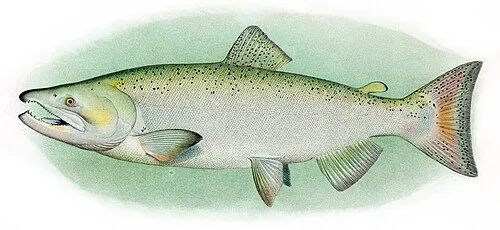
FIELD GUIDE
Oncorhynchus tshawytscha
speciesREVIEWEDThe largest and most valuable Pacific salmon, also called king salmon, quinnat, or tyee. Anadromous, native from California to Alaska and Asian rivers to northern Japan.
HABITAT
North Pacific Ocean and western North American river systems; introduced and thriving in Lake Michigan.
SIZE
typically 10–50 lb, up to 59 kg
IDENTIFY
Ocean-phase Chinook (Oncorhynchus tshawytscha) have blue-green backs with irregular black spots across the back, dorsal fin, and both lobes of the tail fin, plus a black gum line along the lower jaw teeth.
LOOK-ALIKES
Separate Chinook from coho by checking the lower-jaw gum line and tail fin: Chinook show black gums at the tooth base and spots on both upper and lower tail lobes, while coho have a pale gum line and spots confined mostly to the upper lobe.
WHERE
Chinook feed across coastal shelf waters and tide rips from central California to Alaska before entering natal rivers to spawn; ocean feeding depth varies with baitfish layers and coastal upwelling.
WHEN
Distinct spring, summer, fall, and winter runs enter Pacific river systems at different times of year; coastal ocean seasons are set by run-specific abundance forecasts rather than a single calendar window.
TECHNIQUE
Recreational ocean anglers commonly troll spoons, flashers, plugs, or baitfish at controlled depths, or mooch bait along current seams. Many West Coast and Alaska fisheries require barbless hooks — verify tackle rules before dropping gear.
HANDLE
Keep sublegal or unmarked fish in the water alongside the boat when possible, use a knotless rubberized net if netting is required, wet hands, avoid gill contact, and back out barbless hooks cleanly.
CONSERVATION
Several Evolutionarily Significant Units of Chinook are listed as threatened or endangered under the Endangered Species Act, while hatchery and northern stocks support managed harvest. Adipose fin-clip mark-selective rules frequently apply.
RULES
Ocean salmon management areas, mark-selective retention rules, barbless-hook mandates, and in-season quota closures change rapidly. Confirm the exact catch area and current emergency orders before fishing.
SOURCE
FACT-CHECKED 2026-11-13 · REVIEWER fact-check-lane
TEXT CONDENSED FROM WIKIPEDIA, AVAILABLE UNDER CC BY-SA 4.0
King salmon — south of Bluff Point (Cook Inlet salt waters) identification is educational; species identification does not establish legal applicability for Alaska.
- LAST LISTED/REFERENCE LIMITS
- South of Bluff Point: 1 per day and 1 in possession Apr 1-Aug 31; all waters: 1 per day and 1 in possession Sep 1-15; 2 per day and 2 in possession Sep 16-Mar 31.
- LISTED SEASON WINDOWS
- Apr 1, 2026 through Aug 31, 2026 · 1 fish listed
- Sep 1, 2026 through Sep 15, 2026 · 1 fish listed
- Sep 16, 2026 through Mar 31, 2027 · 2 fish listed
- APPLICABILITY
- South of Bluff Point only; the north-of-Bluff-Point schedule is a separate row. In 2026 an emergency order restricted Cook Inlet king salmon; check current ADF&G emergency orders. A combined annual limit of 5 king salmon 20 inches or longer applies across the listed Southcentral areas, and retained kings 20 inches or longer Apr 1-Aug 31 must be recorded. Displayed base rules state no size limit for the bag windows.
- SOURCE AUTHORITY
- ADF&G 2026 Southcentral Alaska Sport Fishing Regulations, General regulations—Cook Inlet & Kachemak Bay salt waters, King Salmon
UPDATED January 1, 2026 · CHECKED Oct 12, 2026, 12:00 PM UTC · EFFECTIVE YEAR 2026
ADF&G sport fishing regulations ↗The ADF&G page is an informational summary; the applicable state statutes and emergency orders are authoritative.
COAST-TO-COAST COMPARISON
King salmon — south of Bluff Point (Cook Inlet salt waters) rules across 2 other coastal states
LAUNCH SITES
Curated launch sites in Alaska (1)
This reference does not grant permission to fish or retain a catch. Location, method, vessel, species identification, and emergency closures can change what applies. Verify the applicable official rules.